
What the job involves
EPA's Consumer's Guide to Radon Reduction calls submembrane suction "the most effective way to reduce radon levels in crawlspace homes." It works by "covering the earth floor with a high-density plastic sheet," then pulling from beneath that sheet with a pipe and fan and venting the gas outside, the same way a basement system does from under a slab.
So the job has two main parts: the membrane on the ground, and the pipe, fan and exhaust. The same EPA rules for those apply in any house. "The exhaust fan must not be located in or below a livable area," and the exhaust belongs above the roof surface and "10 feet or more above the ground." The fan itself can't go in the crawlspace under your living space.
The plastic sheeting
The standards have shifted on this. AARST, the group that writes the national mitigation standards, revised its standard for existing homes in 2023. Its February 2024 bulletin says those changes relaxed the membrane spec over open soil to 6 mil poly.
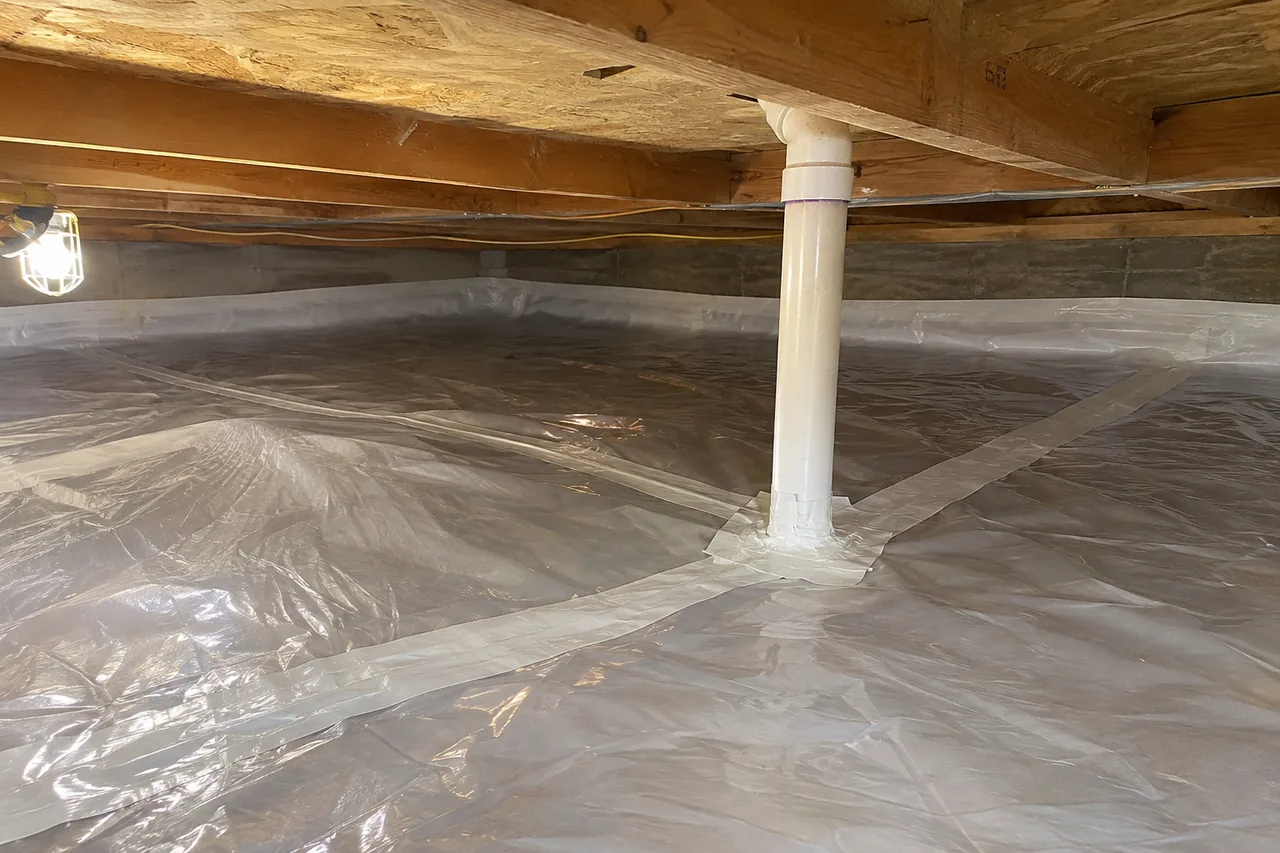
Colorado's rules haven't caught up, though CDPHE's FAQ already describes "6mil poly sheeting in a crawlspace." The rules still cite the 2017 AARST standard, and a state report dated October 15, 2026 says "the Director has not incorporated the revised and updated protocols." In practice, ask which standard the contractor is working to, and what sheeting they plan to use and why. Colorado's law calls for the applicable ANSI/AARST standard or another approved national standard. It doesn't name the 2023 edition.
Encapsulation is a separate job
Crawlspace encapsulation is a different job, and it isn't automatically radon mitigation. No agency source reviewed for this guide says encapsulation alone lowers radon. One Q&A thread on GreenBuildingAdvisor (April 17, 2022) says encapsulation may lower radon but the effect is hard to predict. That's a forum and not an authority, so treat it as a reason to test, not as a finding.
The prices show how different the two jobs are:
| Job | Published national price | Source and date |
|---|---|---|
| Crawlspace radon system | $800 to $3,000 | Bob Vila, July 29, 2022 |
| Crawlspace encapsulation | $1,500 to $15,000 | HomeAdvisor, 2025; Angi, 2022 |
These are national figures and not Colorado prices. For Colorado figures on systems in general, see the cost guide. If a proposal bundles both jobs, ask for each priced on its own line, and ask what each one is meant to accomplish.
Why not just open the vents?
EPA treats natural ventilation as a temporary step and not a lasting fix. If a crawlspace is also where your ducts or plumbing run, tell the contractor. It affects where the sheet can go and how you'd reach things later.
Local numbers and your crawlspace
Larimer County's health page lists an area average of 7.8 pCi/L with no year or sample given. It doesn't break that down by foundation type, and Colorado's notes on its own test records warn that tested homes aren't all homes and that levels can vary widely between neighbors. Test on the lowest lived-in level above the crawlspace, as EPA and CDPHE describe. A crawlspace isn't a lived-in room.
Homes on private wells, as in rural parts of the county, have one more question. EPA says "A radon in water problem is more likely when its source is ground water," and CDPHE says to test water too if you're on a private well with an air problem.
What commonly goes wrong
- Buying encapsulation to solve radon. Test after any crawlspace job. Don't assume.
- Skipping the follow-up test. EPA says test "within 30 days of system installation, but no sooner than 24 hours," and recommends an independent follow-up of 2 to 7 days.
- Sealing and stopping. "EPA does not recommend the use of sealing alone to reduce radon."
- Damage to the sheet later. No source reviewed here gives a repair rule, so ask what to do if it gets torn during other work.
- Missing labels or warning device. "Radon reduction systems must be clearly labeled," and "A warning device must be installed."
- Two foundation types treated as one. If part of the house is over a crawlspace and part over a slab or basement, ask how the design covers each section.
Cost
Colorado's general system figures run $1,000 to $2,000 and about $1,300 to $3,000 on two undated CDPHE pages, with about $1,200 on average, $800 to $2,500 in a state report dated October 15, 2026. None of those is specific to crawlspaces. The national crawlspace figure above is older. CDPHE says "difficult design problems" raise the price, and foundation type and home size and layout affect it. A written quote after a look at your crawlspace is what counts.
Who this isn't for
- Homes with a slab or basement only. See the basement or slab guide.
- Homes with no test. Start with the testing guide.
- People whose main goal is a dry crawlspace. That's an encapsulation or moisture question, and it needs its own advice and pricing.
- Households that may qualify for state help. See the low-income program, which runs separately from this site.
Permits
Permit rules vary, so ask the building department before work begins. EPA says wiring "must be installed according to local electrical codes." Contacts are on the Larimer County page. For questions about sheeting and the rest of the job, see the hiring guide.
Questions homeowners ask
Does crawlspace encapsulation also solve radon?
Not automatically. EPA's named method is submembrane suction, with a pipe and fan. If you encapsulate, test afterward.
What thickness of plastic do I need?
The 2023 AARST changes relaxed the spec over open soil to 6 mil poly, but Colorado's rules haven't taken up that revision. Ask which standard the contractor follows.
Can the fan go in the crawlspace?
EPA says the fan must not be in or below a livable area. A crawlspace under your home is below livable space.
Where do I put the test kit?
On the lowest lived-in level, not in the crawlspace itself. See the testing guide.
Can I still get into the crawlspace afterward?
Ask before the job how the sheet is laid and how to walk on it or move it for service. No source reviewed here sets a rule.
How this site helps
LarimerRadon.com is a referral service: a request here goes to one independent local contractor, who quotes and does any work directly with you. Ask the contractor whether they handle crawlspace work when they call.
Sources
- EPA, Consumer's Guide to Radon Reduction.
- AARST, SGM 2023 technical bulletin (Feb 2024).
- Colorado Department of Regulatory Agencies, radon report (Oct 15, 2026).
- CDPHE, testing page and FAQ (© 2026, undated); state radon dataset notes (undated).
- Larimer County health page (updated Nov 1, 2026).
- HomeAdvisor (titled 2025), Angi (Nov 18, 2022), Bob Vila radon cost guide (July 29, 2022).
- GreenBuildingAdvisor Q&A (Apr 17, 2022, a forum, not an authority).