
The local numbers
Colorado's health department says radon is "responsible for approximately 500 lung cancer deaths annually in Colorado."
| Figure | What it describes | Source, and its limits |
|---|---|---|
| 7.8 pCi/L | "The average radon level in the area is 7.8 pCi/L" | County health page, updated Nov 1, 2026. No year or sample given. |
| 1,147 pCi/L | Highest level the county lists as recorded | Same page. One reading, not a typical house. |
| 1.3 pCi/L | National average, for reference | Same page; EPA uses the same figure. |
| 50% | A caption on the Extension page says 50% of Larimer County homes "have harmful levels of radon." Its text gives about 50% for Colorado homes | County Extension page, Aug 29, 2025. No year or sample. |
| About half | Fort Collins homes tested that reached 4 pCi/L | City radon page, undated. |
| 7.1 pCi/L | Average of 6,900 existing Fort Collins homes | County presentation, undated. Year of data not stated. |
| 5.25 pCi/L; 40.95% at or over 4 | 105 Larimer homes in the 1987-88 EPA and Colorado Geological Survey study | Open-File Report 91-04, 1991. Old and small, but it states a year and sample. Percent is a sum of the report's bands (25.71 + 12.38 + 2.86). The report warns 48-hour tests are a snapshot. |
| 65% | "An average of 65% of homes tested in the Front Range" | County presentation, undated, no sample. |
Colorado figures, which don't agree
| Figure | Source and date |
|---|---|
| About 44% of buildings elevated; about 22% between EPA's consider level and 4 | Colorado Department of Regulatory Agencies report, Oct 15, 2026, citing an Indoor Environments Association report card |
| About half of homes above 4 | Larimer County, Jan 7, 2026; Weld County, Jan 29, 2026 |
| Over 50% elevated | Larimer County health page, Nov 1, 2026 |
| 42.96% of 1,911 tests over 4 | Colorado Geological Survey, 1987-88 tests, published 1991 |
A CDPHE release from 2014 says "all 64 Colorado counties are categorized as Zone 1 for radon," so Colorado's health department classes all counties as Zone 1, meaning a predicted average above 4 pCi/L. EPA's own Colorado sheet says "All homes should be tested, regardless of zone designation," and its map page says the map "should not be used to determine if individual homes need to be tested."
What the geology says
A Colorado state report says radon is "created when uranium in soil or rock breaks down." The Colorado Geological Survey found its 1987-88 results were "strongly influenced by the geologic setting." Its earlier information series paper (1986) says radon "is generated by the decay of radium," and that granites, some black shales, and sands and gravels from granite often run higher in uranium and radium.
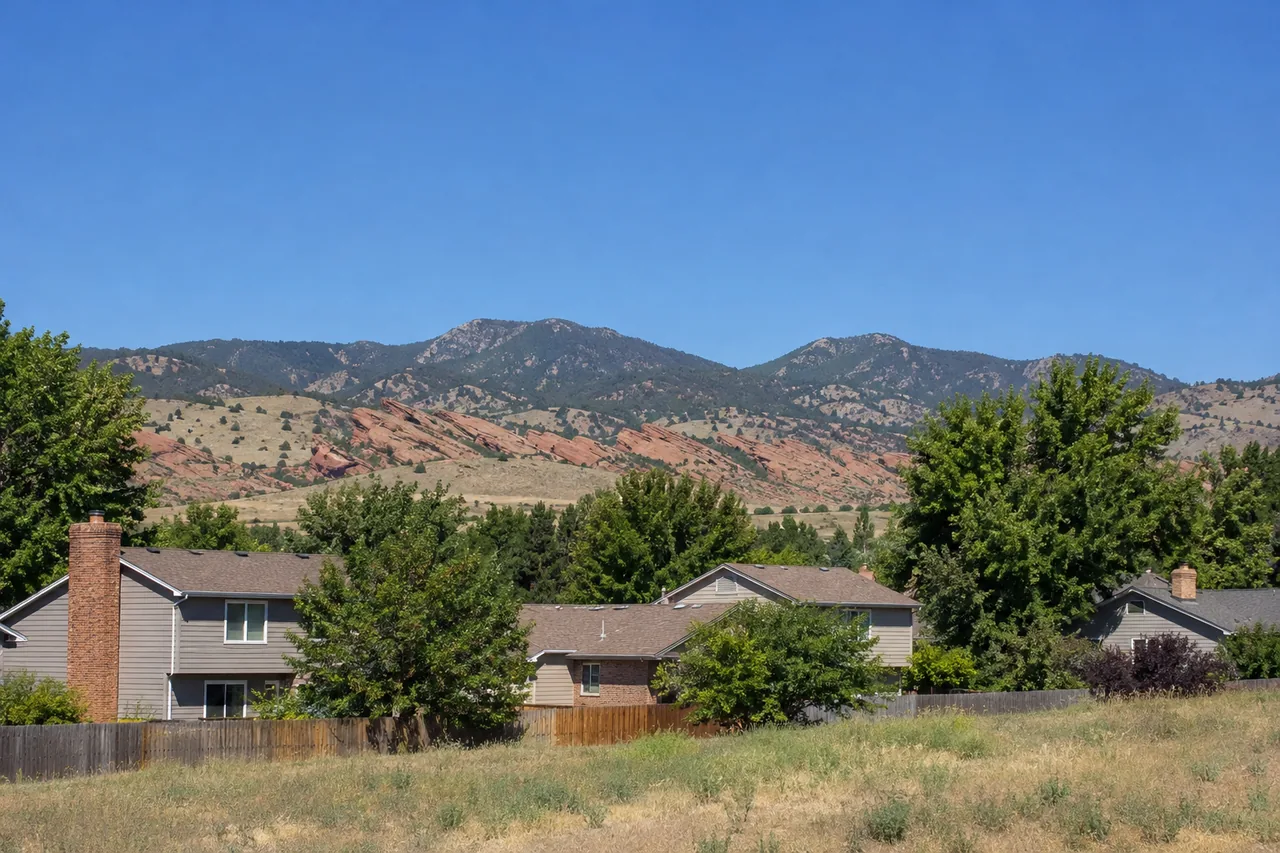
The US Geological Survey's 1964 report on the Front Range describes its core as largely Precambrian crystalline rock, with granites including Silver Plume, Boulder Creek and Pikes Peak. Most uranium deposits it describes are in that rock, mainly in Boulder, Gilpin, Clear Creek and Jefferson counties. Larimer County's output was small; the Copper King mine (652 tons, 1951 to 1953) was an isolated deposit.
That shows uranium-bearing rock exists in the county. It doesn't show that any neighborhood or street runs high, and nothing here maps a Larimer address to a rock type. Test your house.
Where to get a test kit
The county has offered free kits with prepaid postage, most recently in January 2026 "while supplies last," at the two county health offices (1525 Blue Spruce Dr., Fort Collins, and 200 Peridot Ave., Loveland), Estes Park Town Hall, Red Feather Lakes Library, Berthoud Community Library (236 Welch Ave), and online at aelabs.com/larimer. That's seasonal, so call the county at (970) 498-7000 or CSU Extension at (970) 498-6000 and ask. Fort Collins residents have a city program; see the Fort Collins page. The testing guide lists state and store-bought routes.
Building departments and permits
No local page reviewed for this site says whether adding a radon system to an existing home needs a permit. So the honest answer is: permit rules vary, and you should ask the building department before work begins. The county health page advises checking before changing a foundation or electrical system. EPA says a contract should address permits, and wiring "must be installed according to local electrical codes."
| Place | Who to call | What its general page says (none mentions radon) |
|---|---|---|
| Fort Collins | Building Services, 970-416-2740, 281 N. College Ave. | "Most construction projects require a permit." "Permit exempt does not mean code exempt." |
| Unincorporated Larimer | Building Division, (970) 498-7700; inspections (970) 498-7697; 200 W. Oak St., Suite 3100; 8 to 4, Monday to Friday | Most electrical work and alterations need a permit; call before work if unsure. |
| Loveland | Building Division, (970) 962-2505; inspections (970) 962-2100; 410 E. 5th St. | "A building permit is required for new construction, additions, or alterations." |
| Timnath | Building Services, 970-449-4639; building official 970-566-4674; 4750 Signal Tree Dr. | Doesn't say when a permit is needed. 2024 codes effective Jan 1, 2026. |
| Wellington | Building, 970-821-5078, 8225 Third St., Building@WellingtonColorado.gov | Doesn't mention radon. That page reflects the 2018 code and may be outdated. |
| Berthoud | Building, 970-532-2643, option 3; 807 Mountain Ave. | Inspections required during construction and remodeling. |
| Windsor and Severance | See the Windsor and Severance page | Two counties are involved, so they have their own page. |
Those lines are about building work in general. Don't read them as a yes or no about a radon system. Make the call.
New homes
Unincorporated Larimer has required passive radon systems in new homes under its codes, and Fort Collins ran its own test of them in 2006. Read the passive systems guide for what's known and what to ask your building department.
County health contacts
- Larimer County main: (970) 498-7000, 200 W. Oak St., Fort Collins.
- Department of Health and Environment: 1525 Blue Spruce Dr., 2nd Floor, Fort Collins; 200 Peridot Ave., Loveland. Use the main line.
- CSU Extension: (970) 498-6000, 1525 Blue Spruce Dr., extnsn01@larimer.org.
The county's page lists help for low-income households through a state program. See the cost guide.
If you're on a private well
EPA says "A radon in water problem is more likely when its source is ground water." CDPHE says to test the water too if you're on a private well with an air problem. That's worth noting in rural parts of the county.
Questions homeowners ask
Does a county average of 7.8 mean my house is high?
No. It's an average with no stated year or sample. Your house could be well above or well below it.
Why are these numbers so different?
They come from different years, different areas and different groups of homes. Some count only homes people chose to test. That's why each one is shown with its source.
Do I need a permit in Loveland, Wellington, Timnath or Berthoud?
Ask. The numbers are in the table above.
Why no separate page for each town?
For these four, the facts found were phone numbers and permit pages, plus a kit pick-up point in Berthoud. Better one honest page than four near-copies.
How this site helps
LarimerRadon.com is a referral service: a request here goes to one independent local contractor, who quotes and does any work directly with you.
Sources
- Larimer County, health page (Nov 1, 2026), Extension page (Aug 29, 2025), Jan 7, 2026 release, presentation (undated), Building Division.
- City of Fort Collins, radon page; Building Permits.
- Colorado Geological Survey, OF-91-04 (1991), publication page, IS-24 (1986). US Geological Survey, Bulletin 1159 (1964).
- CDPHE, county zone release (Mar 31, 2014); state radon dataset notes (undated); testing page (© 2026). Weld County, radon page (© 2026).
- EPA, Colorado zone sheet, map of radon zones, Consumer's Guide.
- Colorado Department of Regulatory Agencies, radon report (Oct 15, 2026).
- Town and city building pages as linked in the table, read November 2026: Loveland, Timnath, Wellington (page reflects 2018 code), Berthoud.