
Passive or active: the plain difference
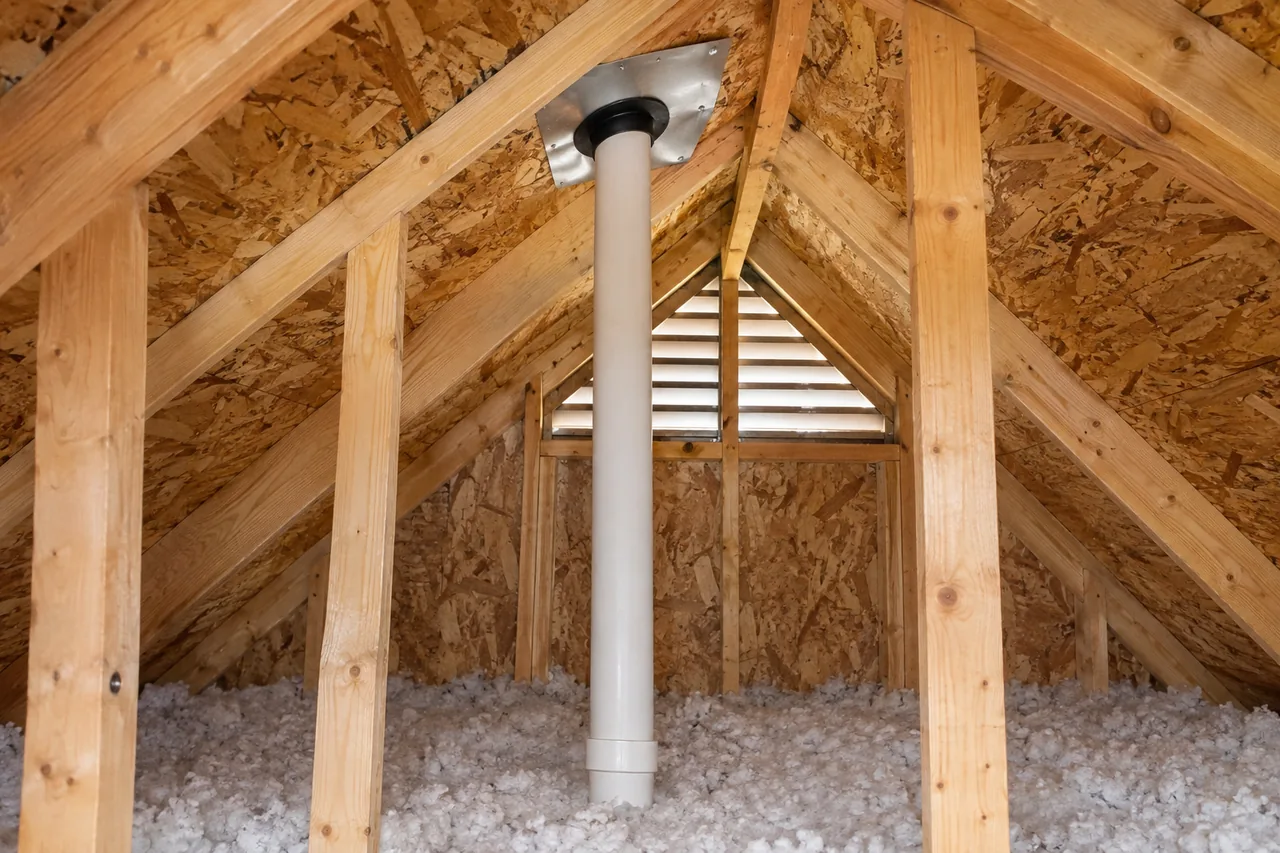
A passive system is a pipe from under the home up through the roof, with no fan. An active system has a fan pulling on that pipe all the time. It's easy to tell which you have: look for a fan on the pipe in the attic, garage or outside wall, and for a warning device. No fan, no active system.
The difference can cost a homeowner. A Colorado state report dated October 15, 2026 describes new-home buyers whose homes were "marketed to them as having a radon mitigation system installed." That wording doesn't tell you whether a fan is running. So ask whether the system is passive or active, then test.
What county code has said
Unincorporated Larimer County's 2021 building code amendments called for passive systems in all new dwellings and in additions over 1,000 square feet (section R333.1). They say "Such systems shall be designed and installed in accordance with Appendix AF". The county's residential guide book says "A passive radon mitigation system is required for all dwelling units," but another page in the same guide narrows that to "certain areas." The two passages don't match.
The county's 2024 code amendments took effect January 1, 2026 (revised August 31, 2026) and still reference radon: "Newly constructed buildings shall provide radon mitigation systems complying with" an appendix to the residential code. The text of that appendix as amended wasn't available for this guide. For what applies to a specific new build, call the county Building Division at (970) 498-7700.
In towns, it depends on the town. A national list from AARST, current as of September 20, 2021, shows Fort Collins and Larimer County with the radon appendix, and doesn't show Loveland, Windsor, Timnath, Wellington, Berthoud, Weld County or Severance. Wellington's own code (Ord. 5-2019) does adopt Appendix F of the 2018 residential code for new construction, so ask what applies now. Not being on that list doesn't mean a town doesn't require one, and the list is old. Call your town's building department and ask. Numbers are on the Larimer County page.
What Fort Collins found in 2006
A Larimer County presentation reports a test of passive systems that the City of Fort Collins ran in 2006, across 65 homes:
| Vent pipe condition | Average reading |
|---|---|
| Vent cap on | 8.0 pCi/L |
| Vent cap off | 4.1 pCi/L |
That's about 50% lower. It's a real improvement, and it also shows why a passive pipe alone doesn't end the question: the average with the cap off still sits above EPA's 4 pCi/L action level. It's an average of 65 homes from one test long ago, and says nothing certain about your house. Colorado's notes on its own test records say levels can vary widely between neighboring homes. Your test decides.
Adding a fan
EPA's technical bulletin on activating a passive system (EPA 402/B-20/007) says when radon is 4 pCi/L or higher, a fan should be installed and activated by a contractor according to state rules.
On price, CDPHE's FAQ says "it should cost about $500 to add a fan." That's CDPHE's figure, undated, and your quote may differ. HomeAdvisor's 2025 national guide gives $500 to $2,500 for installing a passive system and $1,000 to $3,000 for active suction. Those are national prices for different jobs.
Before adding the fan, ask:
- Is the existing pipe suitable as it is, and does it exit correctly above the roof?
- Where will the fan go? EPA says "The exhaust fan must not be located in or below a livable area."
- Is there a power source there, and who handles the wiring? It "must be installed according to local electrical codes."
- What warning device and labels will I get? EPA says both are required parts of a system.
- When is the follow-up test? EPA says "within 30 days of system installation, but no sooner than 24 hours."
What the fan adds to your bill
On Fort Collins Utilities' 2026 time-of-day rates, a 20 watt fan running all year works out to about 175 kWh, or about $21. A 71 watt fan works out to about 622 kWh, or about $74. Those are estimates for this page. The cost guide shows the assumptions, and other utilities charge differently.
What commonly goes wrong
- Assuming you're covered because a pipe exists. Test.
- Finding out at resale. The state report says some owners don't learn systems "were installed improperly until they are selling their homes." The same logic applies to a pipe nobody tested.
- Skipping the test after a basement finish or addition. "After you remodel, retest in the lowest lived-in area."
Who this isn't for
- Homes that test under 2 pCi/L with the pipe as it is. CDPHE's guide says retest, on a schedule. There's nothing to add for now.
- Older homes with no pipe. See the mitigation guide.
- Anyone who hasn't tested. See the testing guide.
Permits
Permit rules vary, and no local page reviewed for this guide names radon fans either way. Ask the building department before work begins. The hiring guide has more to ask the contractor.
Questions homeowners ask
My new home has a pipe. Am I covered?
You have a pipe. Whether your reading is where you want it is a question for a test. The 2006 Fort Collins numbers show why.
Do I need a fan, or can the passive pipe do it?
Test with the pipe as it is. EPA says a fan should be installed at 4 pCi/L or higher.
How much does adding a fan cost?
CDPHE says about $500. The price for your house comes from a contractor's look at it.
Was the builder required to install it?
It depends on where the home is and when it was permitted. Ask your building department.
Should I take the cap off the pipe?
Don't change the pipe without advice. The 2006 test describes vent caps on and off in that study only. Ask the contractor or building department what your pipe is built to do.
How this site helps
LarimerRadon.com is a referral service: a request here goes to one independent local contractor, who quotes and does any work directly with you.
Sources
- EPA, Activating a passive radon system (EPA 402/B-20/007) and Consumer's Guide to Radon Reduction.
- Larimer County, 2021 IRC amendments, residential guide book (2022), 2024 code amendments (revised Aug 31, 2026), indoor air presentation (undated).
- AARST, code adoption data (lists as of Sept 20, 2021).
- CDPHE, FAQ (© 2026, undated); state radon dataset notes (undated).
- Colorado Department of Regulatory Agencies, radon report (Oct 15, 2026).
- HomeAdvisor (titled 2025), national prices by system type.