
What the job involves
A slab home uses the same core method as a basement home. EPA's Consumer's Guide to Radon Reduction calls sub-slab suction "the most common and usually the most reliable radon reduction method." A hole goes through the concrete floor, a pipe is sealed into it, and a fan pulls gas from below and sends it outside. EPA says "Often, only a single suction point is needed," and gives a range of 50 to 99 percent reduction for this method. That range isn't a promise for your floor.
What's different is where it happens. On a slab home, the floor being drilled may be the floor of a room you live in, with no basement or crawlspace to work from. So ask where the suction point could go before anyone drills. Only a look at the house can answer that.
Inside or outside: the pipe route
EPA confirms attic, garage and exterior fan locations and exhaust at roof level, but no source reviewed for this guide ranks the routes on looks or cost. So here are the two options described neutrally:
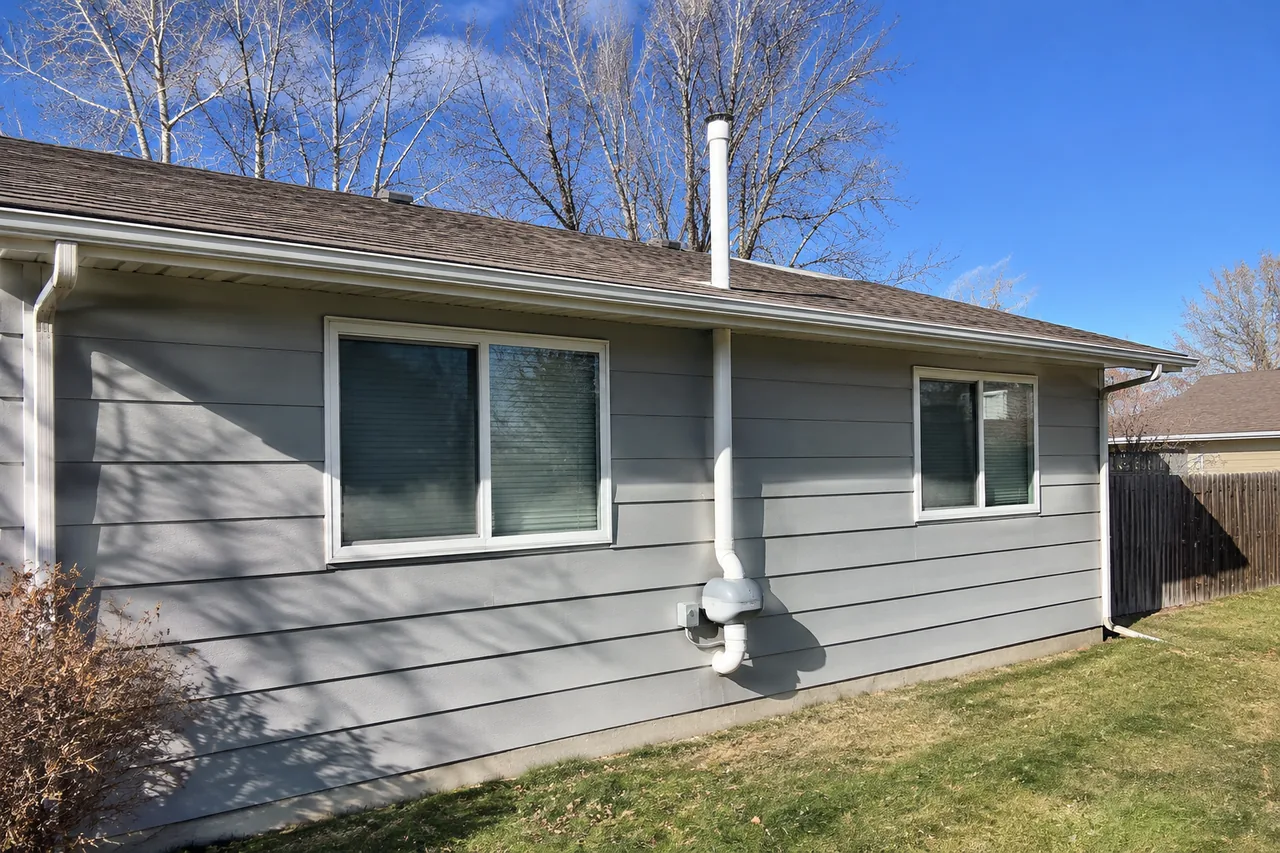
- Through the building. The pipe rises from the suction point through the house to an attic or unconditioned garage, where a fan can sit, then exits above the roof.
- Out and up. The pipe leaves through a wall and runs up the outside of the house to above the roof, with the fan on the exterior.
Before you sign, ask to see the route on paper or marked on the wall, and ask who patches and paints anything that gets opened. If you have an HOA, ask it about outside pipes too. Settle the route before you settle the price, and ask whether the choice changes the number.
The rules that hold either way
- Fan. "The exhaust fan must not be located in or below a livable area." EPA says "Common fan locations include unconditioned home and garage spaces." In a slab home, that rules out the room around the suction point.
- Exhaust. Above the roof surface and "10 feet or more above the ground." If it isn't 2 feet above nearby openings, keep it "at least 10 feet away from windows, doors or other openings." Check those distances yourself on the plan, especially near bedroom windows.
- Wiring. It "must be installed according to local electrical codes."
- Warning device and labels. "A warning device must be installed," and "Radon reduction systems must be clearly labeled."
- Follow-up test. "within 30 days of system installation, but no sooner than 24 hours," plus an independent 2 to 7 day test as EPA recommends.
Local numbers and your slab
Larimer County's health page lists an area average of 7.8 pCi/L, with no year or sample and no breakdown by foundation type. Colorado's notes on its own test records warn, "These data do not give us measures of actual radon levels," and say levels can vary widely between neighboring homes. No source reviewed here says a slab house runs lower or higher than one with a basement, so don't assume either way. Test on the lowest lived-in level, which on a slab is your main floor.
For newer homes, check for a builder's pipe before you plan anything. Larimer County's residential guide says "A passive radon mitigation system is required for all dwelling units," though another line in the same guide narrows that to "certain areas." If you find a pipe labeled for radon, the passive systems guide is the place to start.
What commonly goes wrong
- Route decided on install day. On a slab, the route is what you'll look at for years. Settle it first.
- Sealing as the answer. "EPA does not recommend the use of sealing alone to reduce radon." Sealing slab cracks can support a system but doesn't replace one.
- Exhaust too close to a window. Check it against EPA's distances.
- Appliances not considered. EPA notes a contractor may recommend you "have the appliances checked by a qualified inspector" for backdrafting.
- A remodel later. "After you remodel, retest in the lowest lived-in area."
- Flooring surprises. If the planned suction point sits under finished flooring, ask who removes and restores it.
Worked numbers
A fan that runs all year costs money too, and slab homes are no exception. At 20 watts on Fort Collins Utilities' 2026 time-of-day rates, a fan works out to about $21 a year; at 71 watts, about $74. That's an estimate for this page with assumptions spelled out in the cost guide. It isn't your bill, and other utilities charge differently. EPA says "Fans may last for five years or more," and no source gives a sound local replacement price, so ask.
Cost
Colorado's general figures: $1,000 to $2,000 and about $1,300 to $3,000 on two undated CDPHE pages, and about $1,200 on average, $800 to $2,500 in a state report dated October 15, 2026. They conflict and they aren't specific to slabs. CDPHE says "difficult design problems" raise the price. The written quote after a look at your house is what counts. See the cost guide.
Who this isn't for
- Homes with a basement or crawlspace. See the basement or crawlspace guide. If your house mixes foundation types, ask how the design covers each part.
- Homes with no test yet. See the testing guide.
- Anyone who only wants cracks sealed. EPA doesn't recommend sealing alone.
Permits
Permit rules vary, so ask the building department before work begins. Larimer County's health page advises checking before changing a foundation or electrical system. Contacts are on the Larimer County page, and the hiring guide covers the rest of what to ask.
Questions homeowners ask
Will the pipe be ugly? Can it run inside?
Pipes can run inside or outside, and sources don't rank them. Ask to see both options for your house before you decide.
Does a single-story slab house need a pipe above the roof?
EPA says the exhaust goes above the roof surface and 10 feet or more above the ground, with distance from openings.
Where does the fan go if there's no basement?
EPA's common locations are attics, unconditioned garages and the exterior. It must not be in or below living space.
Do I need a permit?
No local page reviewed for this site says whether adding a radon system to an existing home needs a permit. Call your building department and ask.
How long will the install take?
EPA says to ask and to put the time needed in the contract. No sourced figure exists for this guide.
How this site helps
LarimerRadon.com is a referral service: a request here goes to one independent local contractor, who quotes and does any work directly with you.
Sources
- EPA, Consumer's Guide to Radon Reduction.
- CDPHE, testing page and FAQ (© 2026, undated); state radon dataset notes (undated).
- Larimer County health page (updated Nov 1, 2026); residential guide book (2022).
- Colorado Department of Regulatory Agencies, radon report (Oct 15, 2026).
- Fort Collins Utilities rates (2026).